ECC Memory Design: Error Detection and Correction Implementation
Error-Correcting Code (ECC) memory protects stored data against bit errors caused by radiation, electrical noise, and aging. Rather than simply detecting that data has been corrupted, ECC adds redundant check bits that allow the memory subsystem to locate and repair errors transparently. This guide walks through the mathematics of Hamming and SECDED codes, the hardware that implements them, and the system-level techniques (scrubbing, chipkill, inline vs. sideband ECC) used in production silicon.
Quick Summary
| SEC | Single Error Correction using a Hamming code; corrects any 1-bit error |
| SECDED | Adds an overall parity bit: corrects 1-bit errors, detects 2-bit errors |
| Chipkill / RS | Symbol-based Reed-Solomon coding that survives the loss of an entire DRAM device |
Why Memory Needs Protection
Soft Errors and SEU Sources
A soft error is a transient bit flip that does not physically damage the memory cell — the cell can be rewritten correctly afterward. The dominant cause is a Single Event Upset (SEU), where an energetic particle deposits enough charge to flip a stored bit. Primary sources include:
- Alpha particles: Emitted by trace radioactive isotopes (uranium, thorium) in package and solder materials.
- Cosmic-ray neutrons: High-energy neutrons from atmospheric showers create secondary ionizing particles in silicon; rate rises sharply with altitude.
- Thermal neutrons: Interact with boron-10 (used in BPSG dielectrics), producing localized charge.
Soft error rates are measured in FIT (Failures In Time), defined as one failure per 109 device-hours. As cell capacitance and critical charge (Qcrit) shrink with each process node, individual cells become more susceptible, and a single particle increasingly upsets multiple adjacent cells — a Multi-Cell Upset (MCU). Hard errors, by contrast, are permanent faults from manufacturing defects or wear-out, and require redundancy or remapping rather than simple correction.
Hamming Code Fundamentals
The Hamming Distance Principle
The ability of a code to detect or correct errors derives from its minimum Hamming distance (d) — the smallest number of bit positions in which any two valid codewords differ. A code can detect up to d−1 errors and correct up to ⌊(d−1)/2⌋ errors. A basic single-error-correcting Hamming code has d = 3; adding an extra parity bit raises it to d = 4, giving SECDED.
The Hamming Bound
To correct any single-bit error, the check bits must produce a unique non-zero syndrome for every possible single-bit error location, plus one all-zero state meaning "no error." With m data bits and k check bits, the codeword length is m + k, so the number of distinguishable error positions must satisfy the inequality below.
Hamming Bound for Single-Error Correction
2k ≥ m + k + 1
Where: m = number of data bits, k = number of check (parity) bits. The 2k syndromes must cover the m + k possible single-bit error positions plus the all-zero "no error" syndrome.
Example: For m = 64 data bits, k = 7 gives 27 = 128 < 64 + 7 + 1 = 72? No — 128 ≥ 72 holds, so k = 7 suffices for SEC. SECDED adds one more bit for d = 4, giving k = 8.
Check Bits Required for SECDED
SECDED needs one additional overall parity bit beyond the SEC requirement. The table below shows the standard widths used in commercial memory controllers.
| Data Bits (m) | SEC Check Bits | SECDED Check Bits (k) | Total Codeword | Overhead |
|---|---|---|---|---|
| 8 | 4 | 5 | 13 | 62.5% |
| 16 | 5 | 6 | 22 | 37.5% |
| 32 | 6 | 7 | 39 | 21.9% |
| 64 | 7 | 8 | 72 | 12.5% |
| 128 | 8 | 9 | 137 | 7.0% |
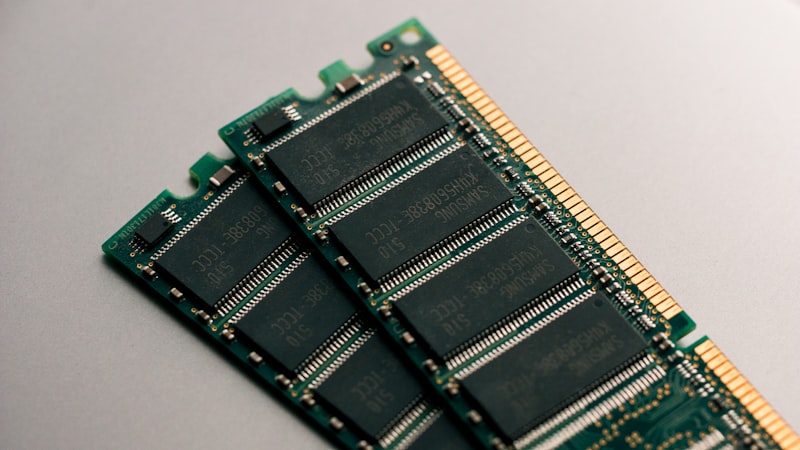
The 64-bit data + 8-bit ECC arrangement is why server DIMMs use 72-bit data paths (eight x8 DRAMs plus one extra) — the 12.5% overhead maps cleanly onto a ninth device.
Check-Bit Calculation and Syndrome Decoding
Generating Check Bits
In the classic Hamming layout, check bits occupy positions that are powers of two (1, 2, 4, 8, ...) and each check bit Pi covers every position whose binary index has bit i set. Each check bit is the XOR (even parity) of its covered data bits:
- P1 covers positions 1, 3, 5, 7, 9, 11, ... (LSB of index = 1)
- P2 covers positions 2, 3, 6, 7, 10, 11, ... (bit 1 of index = 1)
- P4 covers positions 4, 5, 6, 7, 12, 13, ... (bit 2 of index = 1)
- P8 covers positions 8–15, 24–31, ... (bit 3 of index = 1)
In hardware this is implemented as a parity-check matrix (H-matrix) of XOR trees. Practical controllers use optimized H-matrices (e.g., Hsiao codes) that balance the number of 1s per row, minimizing XOR-tree depth and equalizing delay across check bits for better timing closure.
Syndrome Decoding
On read-back, the controller recomputes the check bits from the retrieved data and XORs them with the stored check bits to form the syndrome (S). The syndrome directly identifies the fault condition:
| Syndrome (S) | Overall Parity | Diagnosis | Action |
|---|---|---|---|
| S = 0 | Correct | No error | Pass data through |
| S ≠ 0 | Incorrect | Single-bit error (S = bit position) | Flip the indicated bit (correct) |
| S ≠ 0 | Correct | Double-bit error (DED) | Flag uncorrectable, raise interrupt |
The key SECDED insight: a single error toggles the overall parity bit, while a double error leaves overall parity unchanged but produces a non-zero syndrome — allowing the two cases to be distinguished. A non-zero syndrome that matches no valid bit position also indicates a detected-but-uncorrectable error.
Beyond SECDED: Chipkill and Reed-Solomon
The Multi-Bit Failure Problem
SECDED protects against single-bit upsets, but a complete DRAM device failure corrupts many bits in the same word simultaneously, which SECDED cannot correct. Chipkill (also called Single Device Data Correction, SDDC) tolerates the loss of an entire memory chip.
Symbol-Based Reed-Solomon Correction
Chipkill is typically built on Reed-Solomon (RS) codes operating over symbols (multi-bit groups) rather than individual bits. Because all bits from one x4 or x8 DRAM map into the same symbol, an entire-device failure manifests as a single symbol error. RS codes can correct symbol errors regardless of how many bits within that symbol are wrong. A common implementation interleaves data so that each DRAM contributes to a different symbol of the codeword, then uses RS over GF(28) to correct a full symbol. Modern DDR5 RDIMMs combine on-die ECC with channel-level SDDC for layered protection.
System-Level Reliability Techniques
Memory Scrubbing
Without intervention, a correctable single-bit error sitting in rarely accessed memory can later be joined by a second error, becoming uncorrectable. Scrubbing prevents this accumulation. The controller periodically reads each location, corrects any single-bit error it finds, and writes the corrected value back (read-modify-write). Two modes exist:
- Patrol scrubbing: A background engine sweeps all of memory on a fixed schedule (e.g., once per day), independent of CPU access.
- Demand scrubbing: Triggered on a normal read — when a correctable error is detected during a regular access, the corrected data is immediately written back.
Inline (DDR5) ECC vs. Sideband ECC
Two architectural approaches dominate modern systems:
- Sideband ECC: Traditional server approach. The ECC bits are stored in dedicated extra DRAM devices and transferred over additional data lines alongside the data (the 72-bit-for-64-bit scheme). Correction happens in the host memory controller.
- On-Die ECC (DDR5): DDR5 mandates an internal SEC code inside each DRAM die to correct errors caused by shrinking cells, transparent to the controller. This is separate from, and complementary to, link/sideband ECC. On-die ECC does not report corrected errors to the host by default, so system designers should not treat it as a substitute for controller-side SECDED.
It is important to note that DDR5 on-die ECC alone does not make a non-ECC module equivalent to a true ECC DIMM — full end-to-end protection still requires controller-level ECC across the memory channel.
Implementation Best Practices
- Choose the right code strength: Use SECDED for general-purpose DRAM; escalate to chipkill/RS for high-availability servers and to TMR or stronger codes for aerospace and radiation environments.
- Optimize the H-matrix: Adopt a balanced Hsiao-style parity-check matrix to minimize XOR-tree depth and equalize delay, easing timing closure at high clock rates.
- Pipeline encode/decode logic: Register the syndrome generation and correction stages so ECC does not become the critical path in the memory datapath.
- Always enable scrubbing: Configure patrol scrubbing with an interval short enough that the probability of a second error accumulating before correction is negligible.
- Log and count errors: Maintain correctable (CE) and uncorrectable (UE) error counters; a rising CE rate on a specific address is an early predictor of a failing device.
- Protect the full path: Apply ECC or parity to caches, buffers, and on-chip SRAM — not just external DRAM — for true end-to-end data integrity.
- Verify the corner cases: Use fault-injection testing to confirm correct single-bit correction, double-bit detection, and proper interrupt/poison signaling on uncorrectable events.
Conclusion
ECC memory transforms reliability from a probabilistic risk into a managed, observable property of the system. SECDED Hamming codes provide an efficient first line of defense — correcting single-bit upsets and detecting double-bit errors at modest overhead — while Reed-Solomon-based chipkill and disciplined scrubbing extend protection to whole-device failures and long-term error accumulation.
Selecting the right combination of code strength, H-matrix optimization, scrubbing policy, and error reporting is what separates a memory subsystem that merely runs from one that can be trusted in mission-critical service.
Vcores offers silicon-proven ECC memory controller IP with configurable SECDED and chipkill protection, integrated scrubbing engines, and comprehensive verification for your FPGA and ASIC designs.